Adopting a hardware security module for crypto custody reduces key-exfiltration risk because signing keys never leave the tamper-resistant boundary, but it does not eliminate operational risk. Production custody requires quorum-based key activation, encrypted backup sets stored in separate physical locations, and signed audit logs with monotonic counters. Without these controls, HSM custody can still fail through operator error, policy misconfiguration, or backup loss.
- Require quorum approval from at least two independent operators before any HSM signing operation, including backup and recovery tasks.
- Store encrypted key shares in multiple geographically separate locations and rehearse restoration from backup at least once per quarter.
- Enable monotonic audit counters and verify HSM logs after every signing batch to detect unauthorized key use.
Operating Context and Failure Boundary
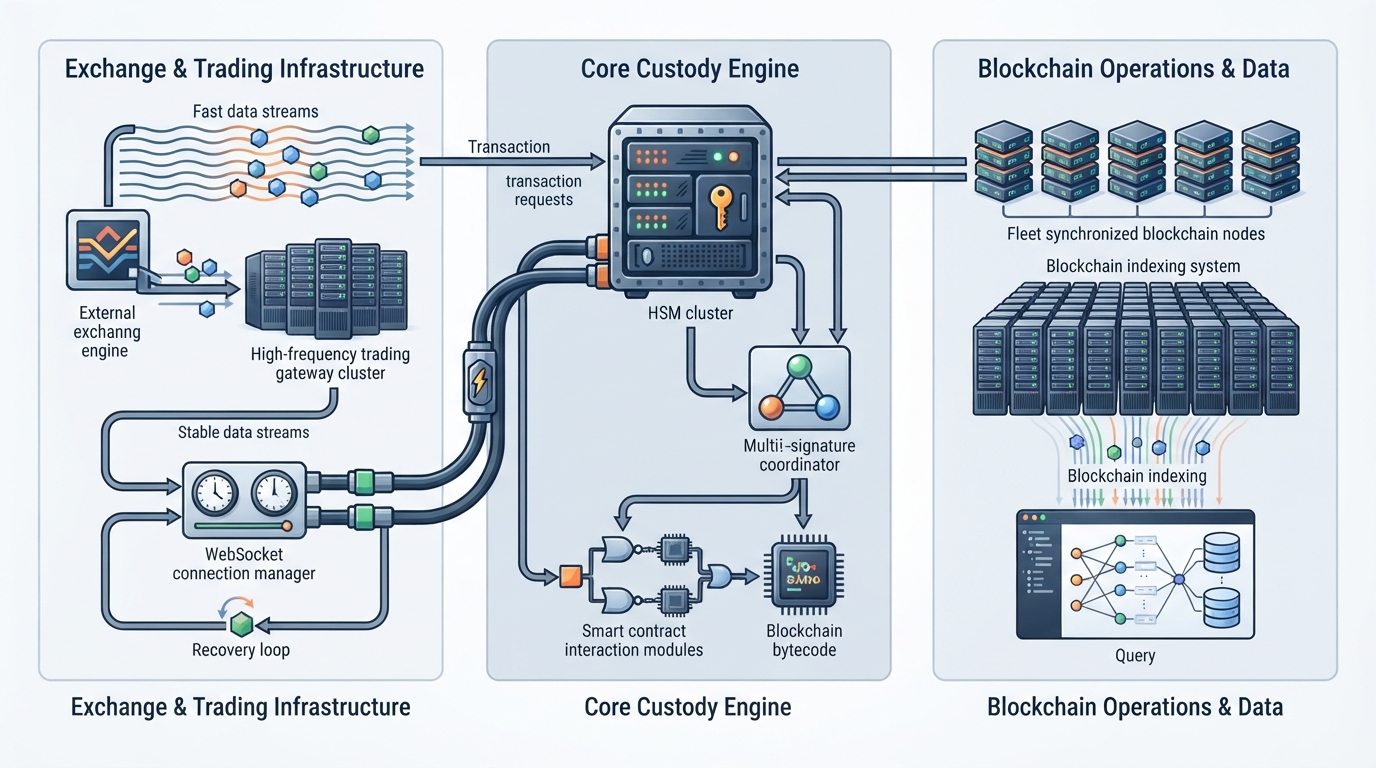
A hardware security module (HSM) centralizes private-key storage and signing inside a dedicated cryptographic processor with physical tamper resistance. The primary failure boundary is not the cryptographic algorithm but the key ceremony and policy configuration that grant access to the signing key. If operators can export a wrapped key or authorize a transaction through a single command, the HSM adds little over a software wallet. Engineers must define which operations require quorum, which backups can be decrypted outside the HSM, and how failed ceremonies are rolled back. FIPS 140-3 Level 3 modules add physical tamper response, but policy controls remain an operator responsibility.
Key Lifecycle and Ownership Model
In HSM custody, the root of trust splits between the device vendor, the operator-controlled administrative keyset, and the quorum of security officers who unlock signing keys. A secure deployment generates keys inside the HSM and exports only encrypted blobs protected by key-encryption keys held on smart cards or another HSM. Ownership is enforced by the vendor-neutral PKCS#11 interface, which exposes signing and key generation but not raw private key material. However, integration risk remains: if the application treats the HSM as a transparent signing oracle, a compromised backend can still submit unauthorized transaction payloads. Therefore, every signing request must include a purpose-bound transaction hash and an application-level authorization token.
Signing Policy, Failure Modes, and Recovery
Production custody fails most often in policy enforcement and backup recovery rather than hardware compromise. Common failure modes include lost quorum cards, expired HSM firmware, network isolation from the signing cluster, and inconsistent key shares after a hardware replacement. Define triggers before deployment: a lost operator card must not block signing if a substitute card with the same role can be issued, and a destroyed HSM must be recoverable from encrypted backup shares using a documented ceremony. Use the following list to map each failure mode to a recovery control:
- Lost quorum card: issue a replacement card from the vendor's administrative channel, rotate the associated auth key, and log the event.
- Hardware failure: restore encrypted key shares to a pre-approved replacement HSM using at least two custodians.
- Policy misconfiguration: revert to a signed baseline policy and block new signings until a two-person review passes.
- Network partition: keep a local signing queue with idempotent transaction hashes and retry after connectivity returns.
Verification and Deployment Decision Criteria
Before moving to production, verify that every signing path records the key handle, caller identity, transaction hash, timestamp, and monotonic counter. Rehearse two drills: restore from the encrypted backup set into a clean HSM, and attempt to sign with an invalid quorum to confirm rejection. Use NIST SP 800-57 guidance to document key states, compromise procedures, and crypto-period limits. Deployment is ready only when signed logs are exportable to an append-only store, each transaction can be traced to an approved quorum, and recovery procedures have been executed at least once. Additionally, monitor HSM firmware versions and schedule maintenance windows before vendor support ends.
Sources
- FIPS 140-3: Security Requirements for Cryptographic Modules NIST · 2019-03-22 · 2026-09-28
- NIST Special Publication 800-57 Part 1 Revision 5: Recommendation for Key Management NIST · 2020-05 · 2026-09-28
- PKCS #11 Cryptographic Token Interface Base Specification Version 3.0 OASIS · 2020-06 · 2026-09-28