Crypto exchange API latency is the sum of venue publish time, network transit, and your own decode-and-apply cost. Because exchange WebSocket feeds deliver messages at-most-once and do not cache offline events, you should keep a local order book from a REST snapshot plus a sequenced diff stream, drop stale updates, resync on any sequence gap, and measure venue-to-receipt time separately from request signing time.
- A sequence gap means the published diff chain broke, so refetch a REST snapshot instead of guessing at missing levels.
- Combined WebSocket connections multiplex several streams without guaranteeing cross-stream order, so never merge trade and book state by arrival time.
- Track percentiles of venue-to-receipt latency and resync counts, because averages hide the tail that decides execution quality.
Where Crypto Exchange API Latency Actually Accumulates
Crypto exchange API latency is not a single number. It combines venue-side matching and publish time, network transit between the venue and your process, and the time your code spends decoding, applying, and dispatching updates. Binance's market-data documentation makes part of this explicit: its prediction order book channel promises delivery within 200 ms of the upstream event, excluding network, and labels delivery as at-most-once. That is the venue's internal budget, not your end-to-end latency, so treat it as a floor. The failure boundary that matters starts when a stream drops, reorders, or skips a sequence number, because a stale local book looks identical to a fresh one until you trade on it.
Order Book Data Flow and Who Owns Each State
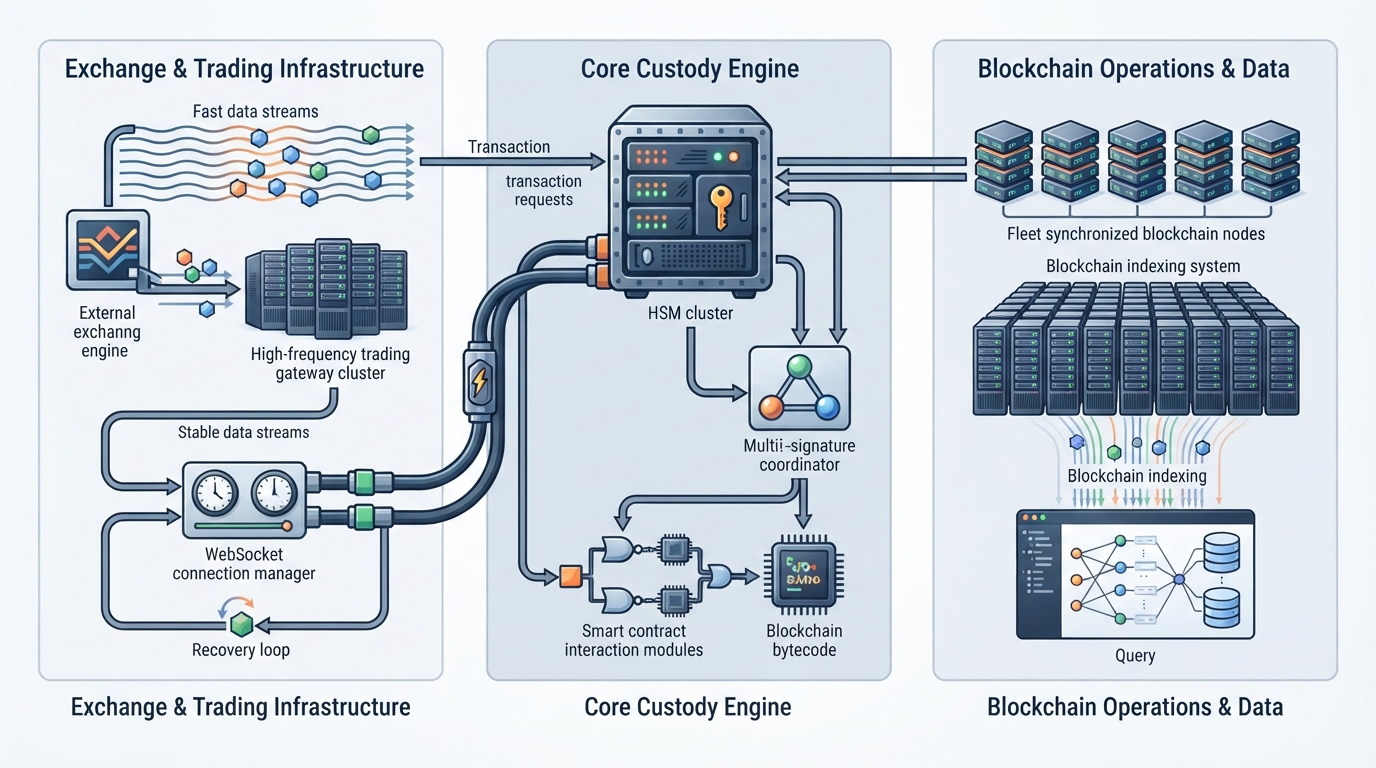
Market data normally arrives as two cooperating parts: a REST snapshot that defines the book at one point in time, and a WebSocket diff stream that describes every change after it. Binance documents combined streams as simple multiplexing, so subscribing to trade and bookTicker feeds on one connection does not create a single ordered timeline, and cross-stream ordering should not be assumed. The exchange owns sequencing and publication; your feed handler owns reconciliation. In practice, keep the diff depth stream as the authoritative source, seed it with a REST snapshot, and derive price and depth from that reconciled book instead of mixing several streams.
Gap Detection, Reconnection, and Recovery Controls
Three failure modes dominate production feeds: sequence gaps, crossed books, and reconnect gaps. BTSE's documentation states that its order book updates carry seqNum and prevSeqNum, that seqNum is always one ahead of prevSeqNum, and that a client should unsubscribe and resubscribe when the sequence breaks or the book crosses. Binance approaches the same problem from the other side: it does not cache offline messages, so a reconnecting client must treat its local book as invalid, fetch a fresh snapshot, and resume applying diffs from that point.
# after a REST snapshot, lastUpdateId is known
if event.u <= lastUpdateId: continue      # stale event, drop it
if event.U > lastUpdateId + 1: resync()   # sequence gap, refetch snapshot
lastUpdateId = event.u
Verifying Latency and Choosing a Deployment Model
Measure latency in pieces rather than one aggregate number. Track venue event time to local receipt, request signing to response, and application apply time separately, then record percentiles because tail behaviour drives strategy outcomes more than averages. Keep counters for dropped messages, resyncs, and reconnect attempts, and alert on resync rate rather than on individual disconnects. Colocation or a region close to the venue reduces transit time but cannot fix a handler that applies updates slowly. Treat stream delay, network placement, and processing cost as separable budgets.
Sources
- Prediction Market — Orderbook WebSocket Push API (Overview) Binance Open Platform · 2026-09-29
- Orderbook Incremental Updates BTSE API Documentation · 2026-09-29
- Ordering guarantees between @trade and @bookTicker streams on a combined-stream connection Binance Developer Community · 2026-09-29